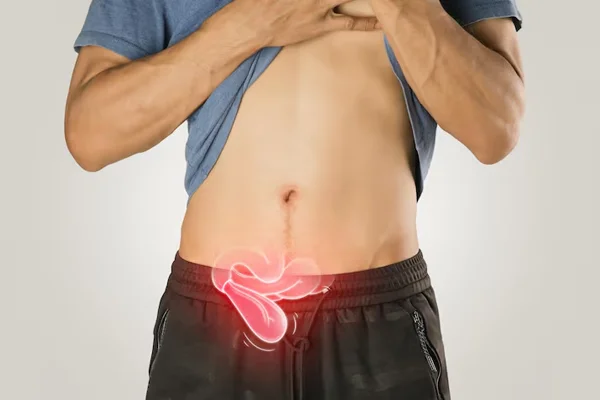
A hernia develops when an internal organ or tissue pushes through a weak area in the surrounding muscle or abdominal wall. It may appear as a visible lump or swelling and can sometimes cause pain, heaviness, or discomfort, particularly while coughing, lifting, or straining.
Dr. Ankit Ahuja is a General and Laparoscopic Surgeon in Faridabad with specialized FNB training in Minimal Access Surgery. He provides evaluation and surgical management for different types of hernias, with laparoscopic techniques considered for suitable patients.
A hernia occurs when tissue, fat, or part of the intestine pushes through a weakened area of the abdominal wall. Hernias commonly occur in the groin or around the belly button, although they can develop at other locations as well.
A hernia may initially cause little or no discomfort. Over time, however, the bulge may become more noticeable or symptoms may increase. The appropriate treatment depends on the location and size of the hernia, symptoms, previous surgeries, and the patient's overall health.
Dr. Ankit Ahuja evaluates patients with different types of abdominal and groin hernias, including:
The treatment approach varies according to the type and complexity of the hernia.
Some hernias may not cause symptoms. When symptoms are present, patients may experience:
The bulge may become more prominent when standing, coughing, or straining and may reduce when lying down.
A painful, hard swelling that cannot be pushed back or does not reduce when lying down can indicate a complication and requires urgent medical assessment.
A hernia can develop because of weakness in the abdominal wall combined with increased pressure inside the abdomen. Some people have a weakness from birth, while others develop a hernia later in life.
Factors that may contribute include:
Having a risk factor does not necessarily mean that a person will develop a hernia.
Diagnosis usually begins with a detailed medical history and physical examination. The surgeon assesses the location and size of the swelling and may examine the patient while standing, coughing, or straining.
In selected cases, imaging such as an ultrasound or CT scan may be recommended to understand the anatomy and assess the hernia more clearly.
The treatment plan is then developed according to the type of hernia, its symptoms, size, previous surgery, and the patient's general health.
Laparoscopic hernia repair is a minimally invasive surgical technique that uses small incisions, a camera, and specialized instruments. The hernia is returned to its appropriate position and the weakened area is reinforced, commonly with surgical mesh depending on the type of repair.
Laparoscopic surgery is not suitable for every patient. Previous abdominal operations, the type and size of the hernia, medical conditions, and other factors can influence the choice between laparoscopic and open surgery.
Dr. Ankit Ahuja assesses each patient individually before recommending the most appropriate surgical technique.
Open hernia repair involves making an incision over or near the hernia so that the surgeon can return the protruding tissue to its appropriate position and repair the weakened area. Mesh may be used to strengthen the repair depending on the type and size of the hernia.
Although laparoscopic surgery can be beneficial for selected patients, open surgery may be more appropriate in certain situations. The choice should be based on individual clinical assessment.
When laparoscopic repair is appropriate, potential benefits can include:
The actual recovery depends on the type of hernia, surgical technique, overall health, and whether the procedure is straightforward or complex.
During laparoscopic hernia surgery, small incisions are made in the abdominal area. A laparoscope with a camera allows the surgeon to view the surgical area on a screen, while specialized instruments are inserted through additional small openings.
The protruding tissue is returned to its appropriate position and the weakened area is repaired. A surgical mesh may be positioned over the defect to provide additional reinforcement where appropriate.
The exact technique varies according to the type and location of the hernia.
Recovery varies from patient to patient. Some discomfort, bruising, or swelling can occur after surgery. Patients are generally advised to gradually increase their activity according to their surgeon's instructions.
After laparoscopic surgery, temporary bloating or shoulder discomfort can sometimes occur because of the gas used during the procedure. These symptoms generally settle with time.
Heavy lifting and strenuous activity should be avoided for the period recommended by the surgical team. Follow-up and wound care instructions should also be followed carefully.
A medical evaluation is advisable if you notice a new lump or swelling in the groin, abdomen, or around the belly button, particularly if it is associated with pain or discomfort.
Urgent assessment is important if the swelling becomes very painful, hard, rapidly enlarges, cannot be pushed back, or is associated with vomiting, abdominal distension, or other concerning symptoms. A trapped or strangulated hernia can require emergency treatment.
Dr. Ankit Ahuja has specialized FNB training in Minimal Access Surgery and advanced experience in laparoscopic and general surgical procedures. His training at GEM Hospital, Coimbatore, has provided focused exposure to minimally invasive and gastrointestinal surgery.
If you have noticed a lump, swelling, or discomfort in the groin or abdominal region, early evaluation can help determine whether you have a hernia and whether treatment is required.
Dr. Ankit Ahuja provides hernia treatment in Faridabad, including evaluation for patients who may benefit from laparoscopic or open hernia repair. The recommended procedure depends on the type of hernia, its size and location, symptoms, previous surgeries, and overall health.
A hernia occurs when tissue or an internal organ pushes through a weak area in the surrounding abdominal or groin muscle.
A visible lump or swelling is common. Some patients may also experience pain, heaviness, pressure, or discomfort while coughing, lifting, or straining.
A hernia generally does not repair itself. Depending on its type and symptoms, a surgeon may recommend observation or surgical repair.
Laparoscopic hernia repair is an established surgical technique, but its suitability depends on the individual patient and type of hernia. A surgeon should assess whether keyhole surgery is appropriate.
Mesh is commonly used to reinforce the weakened area during many hernia repairs, although the exact repair technique depends on the type, location, and characteristics of the hernia.
Recovery varies according to the type of hernia and procedure. Many patients gradually return to routine activities as advised by their surgeon, while strenuous activity and heavy lifting may need to be restricted for a period after surgery.
Severe or increasing pain, a hard or tender swelling that cannot be pushed back, vomiting, or abdominal distension may indicate a complication and requires urgent medical assessment.
A General and Laparoscopic Surgeon can evaluate and treat hernias. Dr. Ankit Ahuja provides surgical consultation and treatment for hernia and other abdominal conditions in Faridabad.


Write a Reply or Comment